
The Iron Valley Gazette
At Riverglen shop class, an engine’s “top end” becomes the day’s main attraction
A community-college teardown turns cylinder heads, camshafts and valves into a live lesson on how air moves through a four-stroke cycle — and why small parts like bearings and rings decide whether the lesson ends in smoke.
EDUCATION
RIVERGLEN — Monday, Jan. 6, 2026
By Mara Ellison
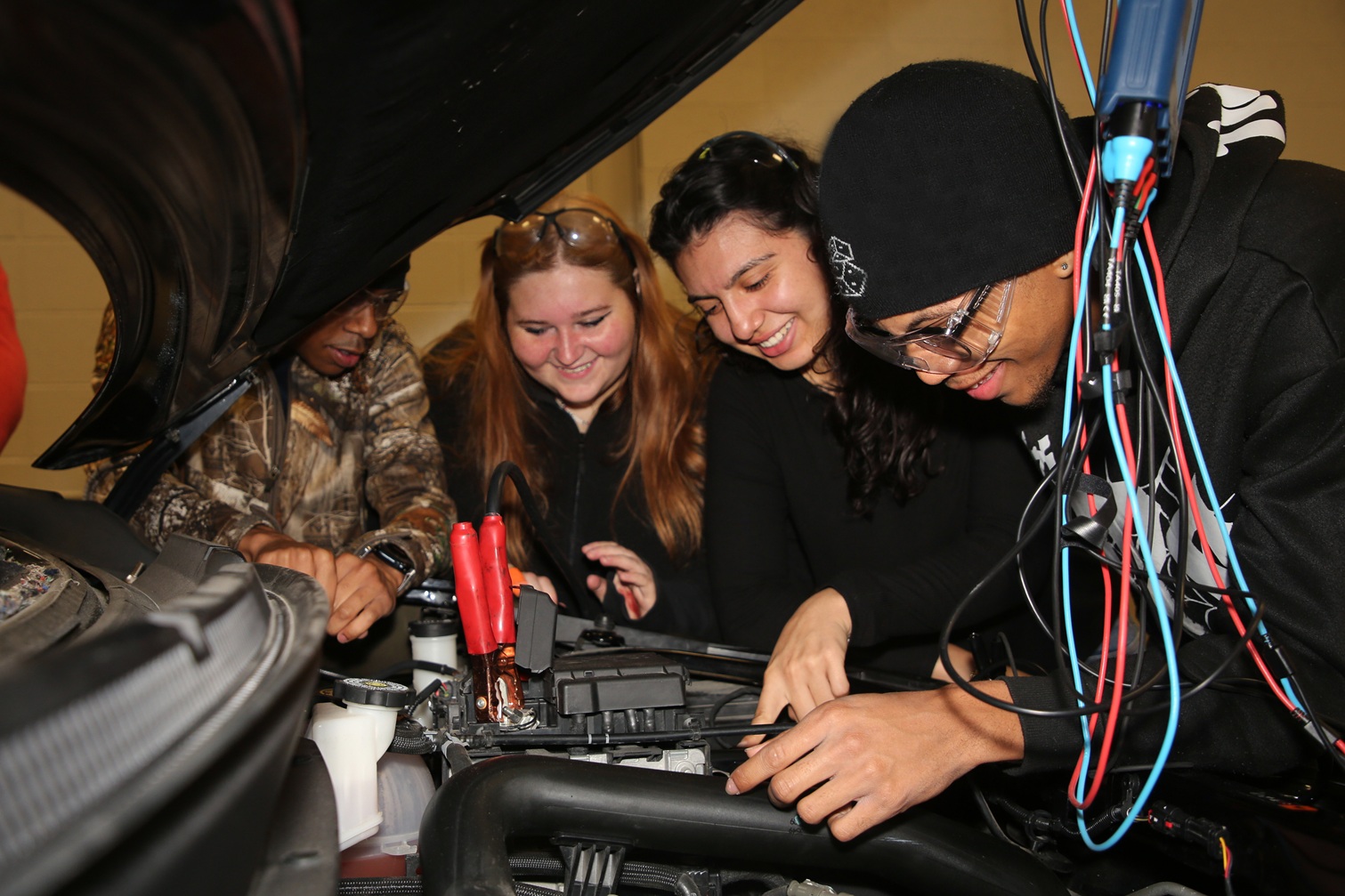
In Bay 3 at Riverglen Technical College, instructor Luis Ramirez held up a cylinder head like a trophy, its ports dark with carbon and its valves seated like closed doors. “This is where the engine breathes,” he told a small crowd of high-school seniors, hobbyists and a few parents who drifted in from the open house, drawn by the click of tools and the smell of solvent.
The demonstration was billed as a recruitment event for the school’s automotive program, but it played out like a practical trial: Ramirez and his students rebuilt the “top end” of a four-cylinder engine on a stand and used the parts in their hands to explain what controls air and fuel going in, and exhaust coming out.
“People think the piston does all the work,” student technician Maya Chen said as she pointed to the exposed combustion chambers. “But up here is where the timing happens.”
Checklist: what was on the bench
On a clean table lined with shop towels, students laid out the parts they said most owners never see until something goes wrong:
- Cylinder head
- Intake and exhaust valves
- Valve springs and retainers
- Camshaft and lobes
- Rockers/followers (as the link between cam and valve)
- Head gasket (set aside for later)
A second tray carried the “supporting cast,” as Ramirez put it:
- Bearings (cam bearings and crank/main bearings, discussed even if not removed)
- Piston rings (compression and oil control)
- Oil sump (oil pan)
The top end: a controlled air gate
Ramirez set the cylinder head down so attendees could see the ports on one side and the combustion chambers on the other. The head, he said, acts as the roof of each cylinder and the home for valves that open and close the passageways.
A student compressed a valve spring in a clamp tool and slid out the tiny keepers that lock the spring retainer in place.
“When the spring is strong, the valve snaps shut and stays shut until it’s told otherwise,” Ramirez said. “If it can’t close, you lose compression. If it can’t open at the right time, you lose breathing.”
He ran a finger along a cam lobe and then mimed its rotation. The lobe, he said, is an intentional bump that pushes the valve open through a follower. When the bump rotates away, the spring forces the valve back onto its seat.
“That’s the whole story of airflow,” Chen said, holding an intake valve next to an exhaust valve. “Two doors, two directions.”
Four strokes, one set of doors
A whiteboard behind the engine stand listed the four-stroke cycle. Students walked the crowd through it using the crank pulley as a handle to rotate the engine.
Intake stroke: With the piston moving down, the intake valve is opened to let air (and fuel, depending on the system) enter the cylinder. The exhaust valve stays closed.
Compression stroke: The piston moves up. Both valves stay closed so the mixture is trapped and squeezed.
Power stroke: After ignition, expanding gases push the piston down. Both valves remain closed to keep pressure in the cylinder.
Exhaust stroke: The piston rises again while the exhaust valve opens, giving spent gases a path out. The intake valve stays closed.
As the crank turned, Ramirez called out the “closed” moments. “Anytime you’re building pressure, you’re begging for a good seal,” he said, tapping the valve seats.
Who controls what: timing versus position
In the middle of the lesson, Ramirez paused the rotation and pointed to two shafts that attendees frequently confuse.
- Camshaft controls valve timing: “The cam decides when the valves open and close,” he said, describing the cam lobes as the schedule.
- Crankshaft reflects piston position: He rotated the crank slightly. “The crank tells you where the piston is. Up, down, halfway — that’s crank position.”
The link between them, he said, is mechanical synchronization.
“If those two lose their relationship, you get noise at best,” he said. “At worst, you get valves trying to occupy the same space as pistons.”
Supporting parts that decide whether it lives
Though the open house centered on the cylinder head, students repeatedly returned to parts that don’t “breathe” but determine whether breathing happens reliably.
Bearings: the quiet reason things stay aligned
Ramirez held up a worn bearing shell with a dull streak along its surface.
“Bearings are why shafts can spin smoothly and stay where they’re supposed to be,” he said. “If a bearing fails, alignment goes away, oil clearance goes away, heat goes up — and then your timing and sealing problems start multiplying.”
He said the camshaft depends on its bearings to keep the lobes tracking correctly across the followers. “A cam that wobbles changes what the valves are doing, even if the parts look fine from a distance,” he said.
Piston rings: sealing and oil control
At a nearby table, Chen showed a piston with its rings removed, sliding a thin ring into a cylinder to demonstrate how it sits in the bore.
“Rings do two jobs people argue about,” she said. “They seal so you can build pressure, and they control oil so it doesn’t flood the combustion chamber.”
A student poured a small amount of clean oil onto the cylinder wall to show the film left behind after wiping. “You want lubrication, not a puddle,” Ramirez said. “Too little and it scuffs. Too much and it burns.”
Oil sump: where the oil ends up between trips
Ramirez pointed beneath the stand at an oil pan removed and set aside. “Everything we’re talking about depends on oil,” he said. “After it does its work, it collects down here in the sump.”
He described the sump as the engine’s collection point, where oil waits to be circulated again. “When levels get low, the first signs aren’t always dramatic,” he added. “It can start as lifter noise, then heat, then wear you can’t un-wear.”
Older mechanical vs. modern systems: the schedule can change
A parent asked whether engines still use the same “fixed” approach Ramirez described.
“The basics are the same,” he said. “Older setups are mostly mechanical schedules — the cam profile is the cam profile, and that’s that. Modern engines can adjust the schedule while they run.”
He did not linger on the details, but he described the idea as changing when valves open and close to suit different conditions. “You can think of it as the engine choosing a different breathing strategy,” he said.
Chen nodded toward the older head on the bench, its passages narrower than those on newer units. “This one teaches the fundamentals,” she said. “Once you can picture the doors opening and closing, the newer stuff makes more sense.”
A lesson written in consequences
As the group dispersed, Ramirez tightened the last fasteners on the reassembled head and reminded the crowd why the top end is often where symptoms show up first.
“If the engine is hard to start, if it’s weak, if it’s smoky — you’re usually chasing air control or sealing,” he said. “That means valves, springs, timing, or the parts that keep everything straight and lubricated.”
The final turn of the crank brought the crowd closer again, watching the cam’s lobes lift each valve in sequence.
“It’s simple,” Chen said, leaning back from the stand. “But it’s not forgiving.”