
The Calderbridge Gazette
AQA Geography Class Turns River Walk Into Lesson on ‘Systems Thinking’
Students map inputs, stores and transfers in a local drainage basin as teachers push back on common misconceptions about what counts as an output.
EDUCATION
CALDERBRIDGE, England — Monday, May 11, 2026
By Rowan Pierce
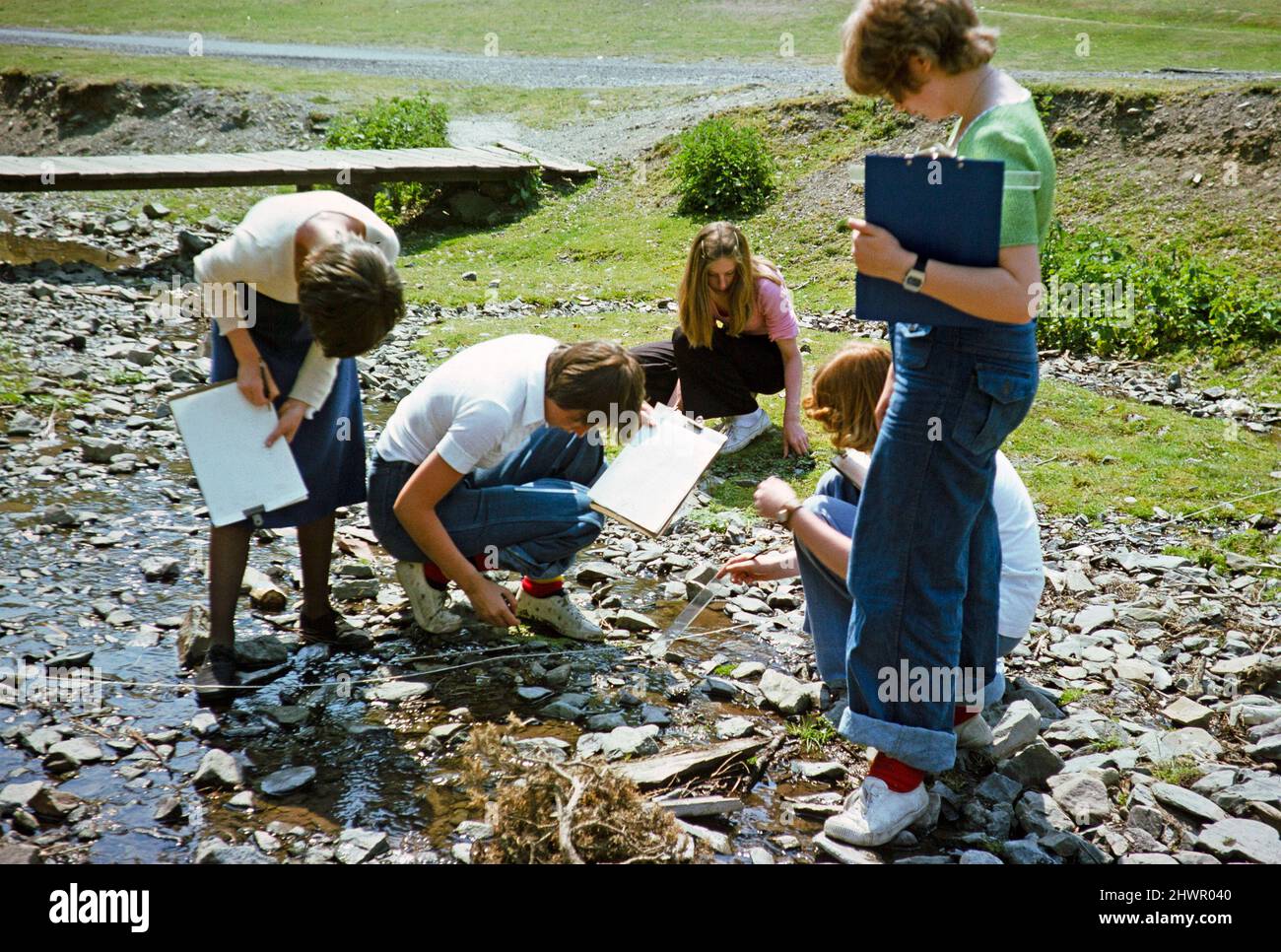
On the banks of the River Laithe, Year 11 students from Calderbridge Community School stood in a loose semicircle, not to memorize definitions, but to decide what, exactly, was “inside” a river system — and what was leaving it.
The lesson began with a taped rectangle on the grass.
“It’s not the river,” teacher Priya Desai told the group, pointing to the boundary line. “It’s the system: interacting components within a boundary. If we can’t agree on the boundary, we can’t agree on what counts as an input or an output.”
Students were handed cards labeled precipitation, infiltration, channel flow, evapotranspiration, soil moisture, and discharge at the gauging station. They were told to place each card either inside the boundary, crossing it, or outside it.
A boundary, then the parts
Desai’s class followed the AQA approach used across physical geography topics — drainage basins, carbon cycling, even glaciated landscapes — treating each as a set of linked components.
“Think of it as a story of movement and storage,” she said. “Water can be held, moved around, or leave.”
Students quickly agreed that soil moisture belonged inside the boundary.
“That’s a store,” said 15-year-old Imran Khalid, pressing the card flat against the grass.
But the class split over channel flow.
“It’s an output,” one student argued.
“It’s only an output if it crosses the boundary,” Desai replied. “If it’s moving within our drainage basin, it’s a flow or transfer. If it leaves the basin — that’s an output.”
A “game system” comparison that stuck
To settle the argument, Desai asked students to describe a game they all knew.
“In a game, you’ve got inventory,” said Maya Thompson. “Like potions, ammo, coins.”
“Inventory is a store,” Desai said, as several students nodded.
“Moving around, crafting, fighting — that’s what you do,” said another student.
“Those actions are like flows/transfers,” Desai said. “They move resources between stores or along pathways.”
Then came the key distinction.
“When you pick up loot from the world, it enters your inventory,” Desai said. “That’s an input. When you drop items, sell them, or lose them permanently — that’s an output. The action of running across the map is movement, but it’s not an output unless it takes something beyond the boundary we’ve set.”
Students returned to their cards with a clearer rule: crossing the boundary changes the system’s budget.
A real geography teaser: the drainage basin
At a small footbridge, the class looked downstream toward a council-installed gauging station.
“Discharge measured here is a number,” Desai said. “But it represents water leaving our defined basin at a point. That’s an output.”
Students listed likely inputs aloud: rainfall, snowmelt in winter, and groundwater moving into the basin from surrounding hills.
They then identified stores: vegetation interception, soil moisture, groundwater, and water in the channel.
And they mapped flows/transfers by pointing, not drawing: overland flow across compacted footpaths, throughflow moving laterally in the soil, percolation downward, and channel flow along the river.
“It’s like the basin keeps a set of accounts,” said student Aisha Rahman. “Water comes in, gets held, gets moved around, and then leaves.”
‘Transfer’ vs ‘output,’ in the students’ words
Desai asked for two sentences — one for a transfer, one for an output.
“Throughflow is a transfer because it moves water from one part of the slope to another but stays in the basin,” said Khalid.
“Evapotranspiration is an output because it leaves the basin to the atmosphere,” Thompson added.
The teacher seized on the phrasing.
“Transfers change where water is within the system,” Desai said. “Outputs change how much water the system has.”
Misconceptions, corrected in real time
The day’s most common mistakes emerged as students debated their choices.
Misconception 1: “Any movement is an output.”
When one group labeled channel flow an output, Desai asked where the water was going.
“If it’s still inside the boundary, it’s not leaving,” she said. The group re-labeled it as a transfer.
Misconception 2: “Stores are permanent.”
A student insisted groundwater was “basically stuck.” Desai pointed to a nearby spring.
“Water stored in rock can still move and reappear,” she said. “A store can fill and empty.”
Misconception 3: “The boundary is always obvious.”
Several students assumed the riverbanks were the boundary.
“A drainage basin boundary is the watershed — the high ground — not the channel edge,” Desai said, gesturing toward the hills above the town.
Why the school is leaning into the approach
Assistant headteacher Mark Ellison said the department has been emphasizing systems thinking because it travels across topics.
“If they can track inputs, outputs, stores and transfers here, they can do it with carbon in a woodland, sediment on a coastline, or energy in an ecosystem,” Ellison said.
At the end of the session, students were asked to write a single line for their notebooks. Many kept it simple.
“A system is interacting components inside a boundary,” Rahman wrote, “and we can explain change by following what comes in, what moves, what’s stored, and what leaves.”