
The Ashton Ledger
District Rolls Out ‘Lab Bench Cheat Sheet’ as Students Stumble on Density
One-page review guide emphasizes matter, measurement and units after midyear lab reports show repeat errors in mass, volume and significant figures.
SCIENCE & EDUCATION
ASHTON, Maine — Tuesday, January 13, 2026
By Marisol Vega
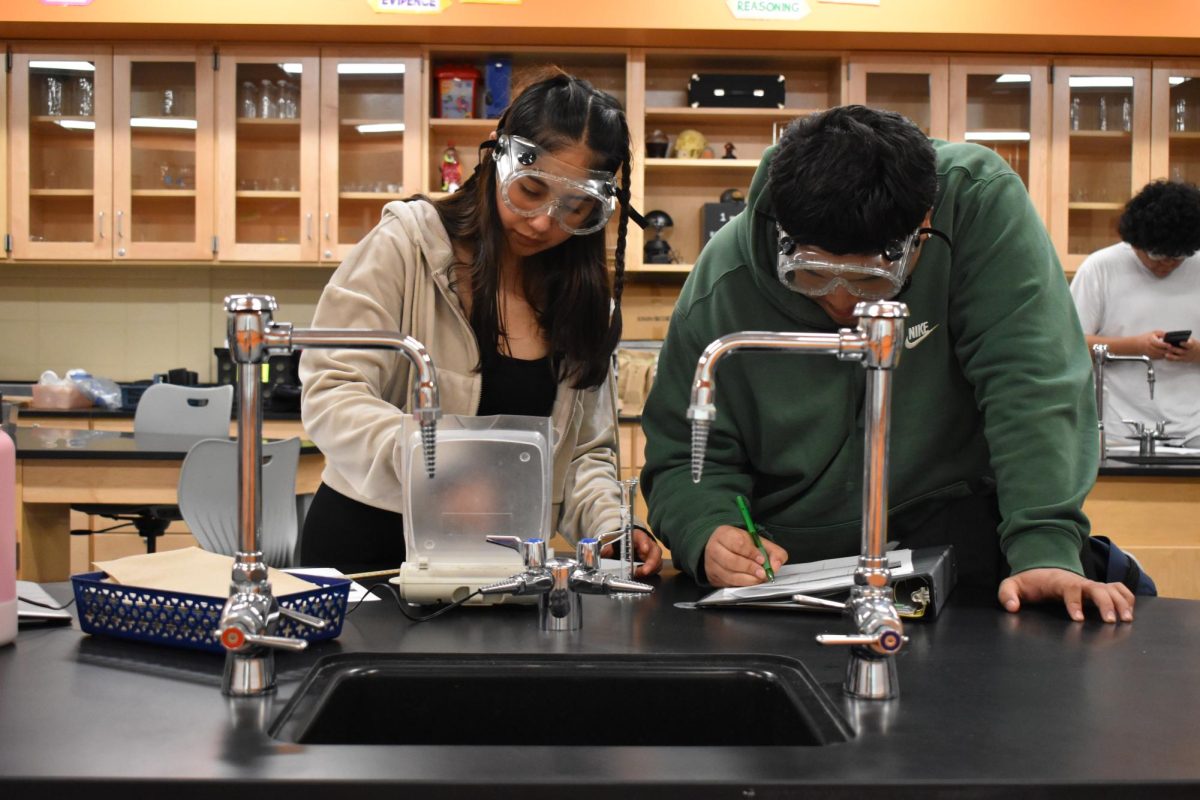
After a round of midyear lab reports revealed the same mistakes across classrooms — swapping mass for volume, dropping units and claiming density changes when samples get larger — Ashton Public Schools is sending every middle- and high-school science student home with a one-page “Lab Bench Cheat Sheet” this week.
Science teachers said the memo-like handout is designed less like a chapter and more like a checklist. “It’s what you want taped inside a notebook: quick definitions, the tools you actually touch, and the reminders that keep labs from going sideways,” said chemistry teacher Nolan Price, who helped draft the guide.
What counts as matter
The handout opens with a definition in bold type: Matter is anything that has mass and takes up space (volume).
In a classroom demonstration last week, Price held up a metal bolt and an inflated balloon. “Different materials, same rule,” he told students. “If it has mass and it occupies volume, it’s matter.”
Intensive vs. extensive properties (quick table)
Teachers said confusion over properties showed up in lab conclusions, especially when students described a substance “changing” because a larger sample had a larger mass.
| Property type | Depends on amount of matter? | Examples students saw in labs |
|---|---|---|
| Intensive | No | density, color, temperature, melting point |
| Extensive | Yes | mass, volume, length, total energy |
“Doubling the sample doubles the mass and volume,” said eighth-grade teacher Lila Chen. “But density is a ratio — it’s supposed to stay the same for the same material under the same conditions.”
Measurement tools and SI units in the lab
The handout lists common tools and their typical units, reflecting what students use in the district’s labs.
- Mass: electronic balance (or triple-beam balance) — grams (g) or kilograms (kg)
- Volume (liquids): graduated cylinder — milliliters (mL) or liters (L)
- Volume (solids): ruler for regular shapes — centimeters (cm) and cubic centimeters (cm³); water displacement in a graduated cylinder for irregular shapes — mL
- Length: metric ruler or meter stick — meters (m), centimeters (cm)
- Temperature: thermometer or probe — degrees Celsius (°C) (science teams noted Kelvin (K) appears in advanced units later in the year)
Lab aides said the guide also prompts students to record units with every number. “A ‘12’ isn’t helpful without ‘g’ or ‘mL,’” said lab technician Reina Sato.
Density: formula and unit reminders
At the center of the page, the district printed the equation in large type:
Density (D) = Mass (m) ÷ Volume (V)
Then, in a smaller note, it flags two common unit pairings used in school labs:
- g/mL for liquids
- g/cm³ for solids
Teachers pointed out a key bridge students often miss: 1 mL = 1 cm³, which makes unit conversions smoother when comparing a liquid measurement to a solid’s displaced volume.
5-step checklist for density problems
The bottom of the sheet is a short sequence intended to mirror how students should write solutions on lab worksheets:
- Write what you’re given (include units).
- Choose the formula: D = m/V.
- Convert units if needed (mL ↔ cm³; g ↔ kg when required).
- Calculate and label the answer with units (g/mL or g/cm³).
- Round properly to the correct significant figures and double-check reasonableness.
Common mistakes teachers say keep repeating
Staff members said the “mistakes” section was written after teachers compared notes across grade levels.
- Mixing up mass vs. volume: Students sometimes divide the wrong way or treat volume as “how heavy” something feels.
- Thinking density changes with the amount: Larger samples have more mass and more volume, but the ratio can remain the same.
- Forgetting units: Numbers without units have been a frequent reason for partial credit or lab redo requests.
- Over-reporting digits: Some reports listed long calculator readouts, which teachers said suggests false precision.
Superintendent Dana Morales said the district will pair the handout with short “units checks” at the start of each lab. “We’re not trying to make science smaller,” Morales said. “We’re trying to make the basics automatic so students can focus on the questions that come after the measurements.”