
The Northbridge Sentinel
Chemistry Teachers Push ‘Four-Step’ Method as Students Stumble From Words to Equations
A districtwide lesson uses real lab mishaps and quick ratio reads to turn reaction descriptions into balanced chemical equations — and into clean mole conversions
SCIENCE & EDUCATION
NORTHBRIDGE — Monday, January 12, 2026
By Mariah Ellison
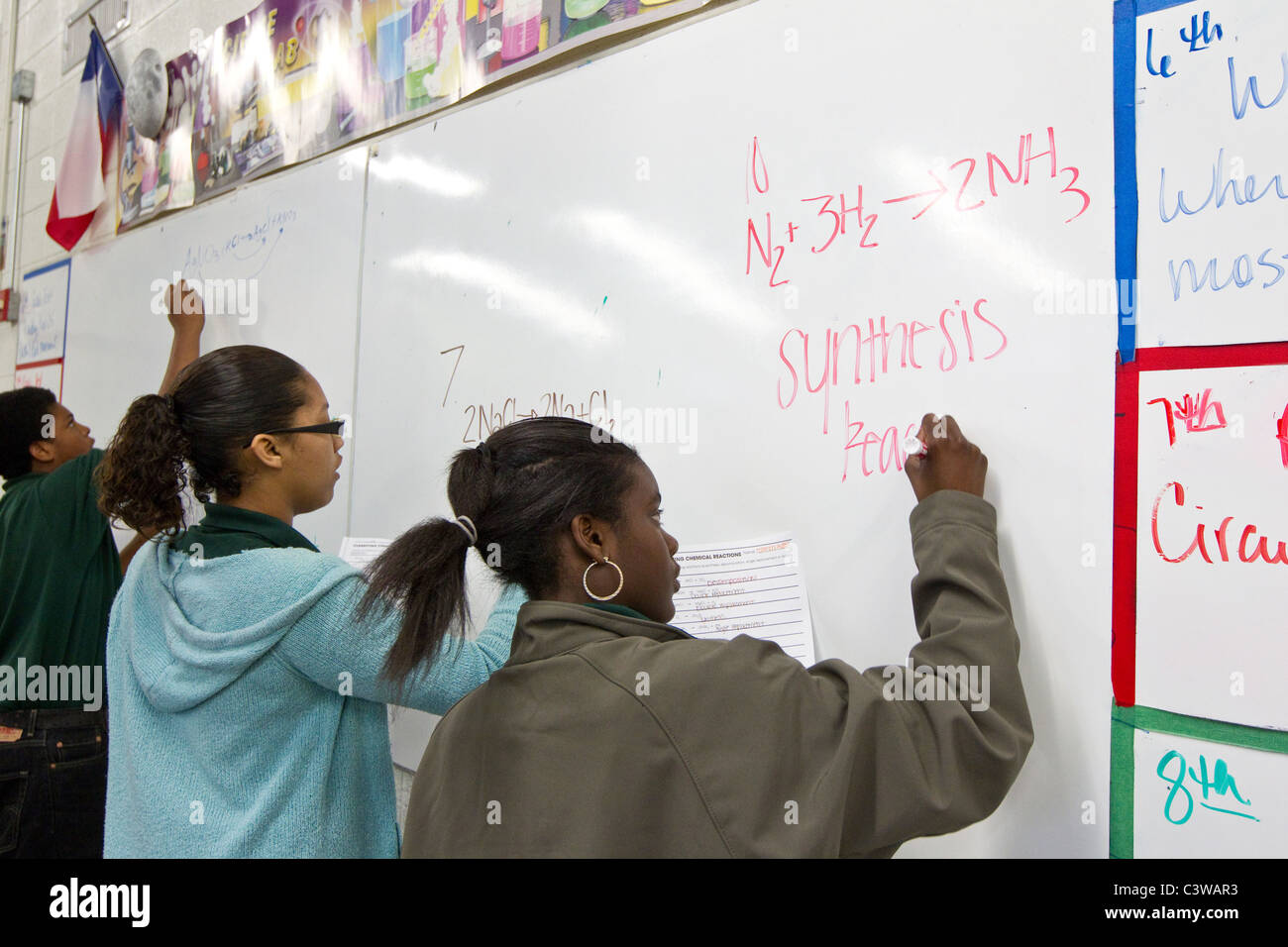
In Room 214 at Northbridge High School, a small crowd of juniors leaned over lab benches as chemistry teacher Lena Ortiz circled four words on the board: reactants, products, balance, ratios. The district’s science department says that sequence — written as a workflow — is cutting down on the most common errors students make when translating word descriptions into balanced chemical equations and then using the coefficients to set up mole-to-mole conversions.
Ortiz’s students were not short on motivation. A week earlier, a lab group had reported “making water” and turned in an equation that began with H + O → H2O.
“That’s how you get the right-sounding story with the wrong chemistry,” Ortiz told the class, holding up the returned paper. “We don’t guess. We translate.”
Northbridge Public Schools introduced the new approach after a semester review found that many students could memorize reaction types, but faltered when asked to move from a sentence to a balanced equation — and then stalled again when asked what the balanced equation means for amounts.
The four-step workflow, taught like a checklist
The method is being posted in classrooms and printed on lab handouts:
- Identify reactants and products from the words.
- Write correct formulas for each substance.
- Balance with coefficients only.
- Read mole ratios directly from the coefficients.
District science coordinator Ravi Menon said the goal is to make students pause at the point where most mistakes begin — the formulas.
“Students rush to balancing because it looks like the ‘math part,’” Menon said. “But balancing can’t fix a wrong formula. You can only balance what you wrote.”
In class, Ortiz treated the checklist like a preflight routine. “If step two is wrong, step three becomes a magic trick,” she said.
Example 1: Combustion — when ‘burns’ means oxygen is involved
Ortiz wrote a short description on the board: Propane burns in oxygen to produce carbon dioxide and water.
Students first highlighted reactants and products. Then came formulas:
- Propane: C3H8
- Oxygen gas: O2
- Carbon dioxide: CO2
- Water: H2O
Ortiz asked for an unbalanced skeleton equation:
C3H8 + O2 → CO2 + H2O
Balancing, she guided students to match atoms using coefficients:
C3H8 + 5 O2 → 3 CO2 + 4 H2O
“Now the payoff,” Ortiz said, tapping the coefficients. “These are not decorations. They’re the recipe.”
From the balanced equation, students read ratios without adding numbers or changing subscripts:
- 1 mol C3H8 reacts with 5 mol O2
- 1 mol C3H8 produces 3 mol CO2
- 5 mol O2 produces 4 mol H2O
Senior lab aide Mason Kline said the ratio readout helped him avoid guessing.
“When I see ‘propane,’ I used to think it’s 3-to-8 or something because of subscripts,” Kline said. “Now I only use the big numbers in front. The subscripts are the identity of the compound — the coefficients are the amounts.”
Example 2: Synthesis — making an ionic compound without inventing charges
The next prompt: Magnesium reacts with nitrogen to form magnesium nitride.
Ortiz paused the room at step two.
“Magnesium nitride is ionic,” she said. “So the formula comes from charges, not from the word ‘nitride’ alone.”
Students wrote:
- Magnesium: Mg
- Nitrogen gas: N2
- Magnesium nitride: Mg3N2
Skeleton equation:
Mg + N2 → Mg3N2
Balanced equation:
3 Mg + N2 → Mg3N2
Ortiz pointed to the coefficients: “This is where conversions come from.”
Ratios:
- 3 mol Mg react with 1 mol N2
- 3 mol Mg produce 1 mol Mg3N2
Menon said this example exposes a common misunderstanding: students try to “balance” the ionic formula itself.
“They’ll write MgN because it ‘looks balanced,’” Menon said. “But chemistry doesn’t care what looks even. The charges determine the formula; coefficients determine the amounts.”
Example 3: Decomposition — when a single reactant makes multiple products
Finally: Potassium chlorate decomposes to form potassium chloride and oxygen gas.
Formulas were written first:
- Potassium chlorate: KClO3
- Potassium chloride: KCl
- Oxygen gas: O2
Skeleton equation:
KClO3 → KCl + O2
Balanced equation:
2 KClO3 → 2 KCl + 3 O2
Ortiz asked students to “read” the equation like a sentence with quantities.
“Two units of potassium chlorate break into two units of potassium chloride and three units of oxygen,” said junior Alina Park, translating the coefficients into words.
Ortiz nodded and underlined the conversion-ready ratios:
- 2 mol KClO3 produce 3 mol O2
- 2 mol KClO3 produce 2 mol KCl
A nearby lab station had a small jar labeled “O2 (demo only).” Ortiz said the label was deliberate.
“When you see oxygen in products, students will write O,” she said. “But in this class, oxygen shows up as O2 unless it’s part of a compound.”
Spot the trap: the mistakes that keep showing up
The district’s handout includes what Ortiz called a “trap list” — errors that look small but derail the entire setup.
Wrong formulas from name confusion
Ortiz held up a worksheet where a student had written calcium nitrate as CaNO3.
“That’s a name you translate, not a word you copy,” she said, noting that nitrate stays as NO3 with a charge that forces Ca(NO3)2. “If you start with CaNO3, balancing won’t save you.”
Confusing subscripts with coefficients
In the propane example, several students first tried to change C3H8 to C3H16 to “get enough hydrogen.” Ortiz stopped them.
“Subscripts are part of the chemical identity,” she said. “Changing them is like changing the name of the chemical mid-problem.”
Missing diatomic elements
Ortiz listed the usual offenders in student work: hydrogen, nitrogen, oxygen, fluorine, chlorine, bromine, iodine.
“You don’t get to decide if nitrogen is N or N2,” she said. “Nature already decided.”
Balancing by changing subscripts
Menon said this remains the most persistent error because it appears to work.
“If you need four oxygen atoms and you turn O2 into O4, your atom count might match,” he said. “But you have invented a new substance.”
Ortiz’s rule on the board was blunt: “Balance only with coefficients.”
The immediate ratio step, not an afterthought
What makes the lesson different, teachers said, is that it doesn’t end at balancing.
Ortiz asked students to circle each coefficient and write a quick ratio statement next to it — not a full calculation, just the conversion relationship.
“In our labs, we don’t stop at a pretty balanced equation,” Ortiz said. “We stop when we can say, confidently, what reacts with what and what forms from what — in moles — because that’s how you set up everything else.”
By the end of class, students were handing in exit slips with four lines: reactants, products, balanced equation, and one ratio they could use to convert between substances.
Ortiz flipped through them, pausing at a combustion slip where a student had written O2 correctly.
“That’s the difference between a guess and a translation,” she said. “And once you translate it right, the ratios are already sitting there waiting for you.”