
The Harbor City Sentinel
Quake Ripples Help Scientists Read the Planet Like a Layer Cake
After a small offshore tremor, local students tracked “push” and “wiggle” waves and watched them vanish and bend — clues that point to a liquid outer core and sharp boundaries deep below.
SCIENCE & EDUCATION
HARBOR CITY — Jan. 30, 2026
By Mara Ellison
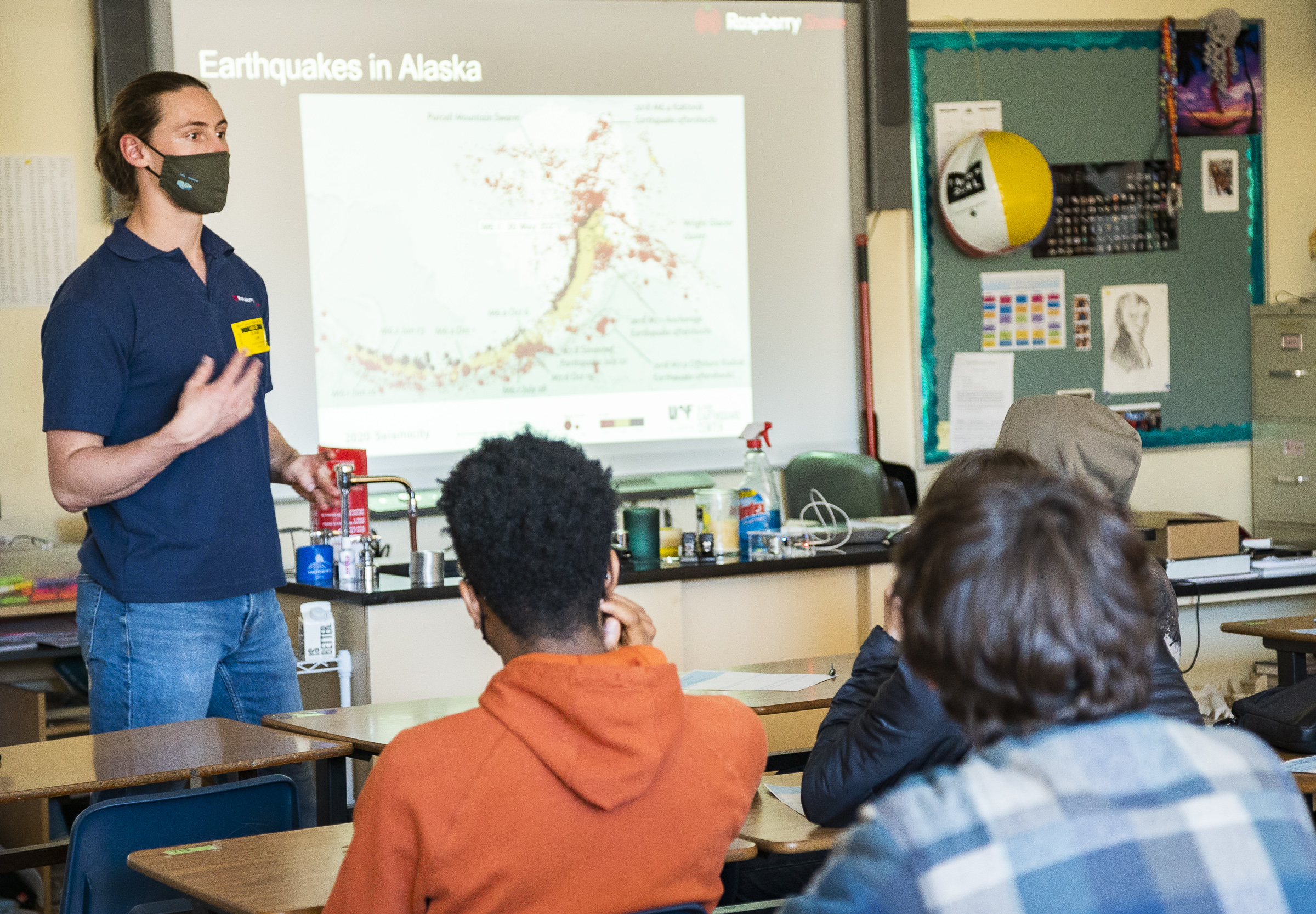
When a modest earthquake rolled through the ocean floor 140 miles west of Harbor City last week, it did more than rattle hanging lamps along the waterfront — it delivered a clean set of seismic signals that let scientists and students trace the hidden layers of Earth, from thin crust to a deep, molten shell around the core.
At Harbor City University’s seismology lab, a printer-sized instrument called a seismometer drew the quake’s passage as thin, jagged lines. The first set of squiggles arrived quickly and sharply.
“Think of it like a push,” said Dr. Lina Varga, a geophysicist who hosted a group of fourth- and fifth-graders from Seaside Elementary. Varga pressed her hands together and shoved gently forward. “That’s a P-wave — a push-pull motion that squeezes and stretches the ground in the same direction the wave travels.”
A second set of lines followed, arriving later and looking broader on the screen.
“Now imagine you’re holding a jump rope,” Varga told the students, moving her hand side-to-side. “That’s an S-wave — a side-to-side wiggle. The ground moves across the direction the wave is going.”
The lab’s screens showed both waves racing outward from the quake in all directions — until, on maps of the wider world, the wiggle waves stopped.
The wave that won’t swim
S-waves can travel through solids, but they do not pass through liquids. That fact, repeated often in classrooms, became practical when the students watched a global map update with reports from distant seismic stations.
“Why does it disappear?” asked 10-year-old Harper Nguyen, pointing at a blank arc on the map.
“Because something inside Earth is acting like a pond,” Varga replied. “A wiggle wave can’t move through it.”
That missing arc is known to scientists as an S-wave shadow zone — a region on the far side of Earth where stations do not record S-waves from a given quake. The absence is not random. It forms a consistent pattern that has been seen after thousands of earthquakes.
At the Coastal Geologic Survey, analyst Mateo Rios said the pattern remains one of the simplest lines of evidence for a liquid outer core.
“It’s not that the waves get tired,” Rios said. “It’s that the material changes. The shadow zone tells us there’s a big layer down there where S-waves can’t go.”
What “boundaries” look like — without anyone seeing them
Scientists use the word “boundary” for a place inside Earth where material changes enough to affect how seismic waves move — like a sudden change in the kind of rock, how tightly it’s packed, or whether it’s solid or liquid.
“You can’t drill to those depths,” Varga told the students. “But you can see their fingerprints in the timing.”
Those fingerprints show up as waves that speed up, slow down, bend, or reflect — much like sound changing as it travels from air into water.
In Harbor City’s lab, graduate student Priya Deshmukh pulled up a graph of wave arrival times from stations at different distances.
“You see this kink?” Deshmukh said, tracing a bend in the line with her finger. “That’s a boundary. The waves are telling us they hit a new layer.”
Two boundaries featured prominently in the week’s lesson:
- The Moho (Mohorovičić discontinuity): the boundary between Earth’s crust and the mantle.
- The core–mantle boundary: the deep boundary where the solid mantle meets the liquid outer core.
The Moho is shallow enough, geologically speaking, that its effects show up quickly in seismic records. After waves cross it, their speeds change because the mantle’s rock differs from the crust above.
The core–mantle boundary, far deeper, does something more dramatic.
Shadow zones and the case for a liquid outer core
On a world map, the lab’s software highlighted where stations recorded P-waves, S-waves, both, or neither.
P-waves, the push-pull type, travel through solids and liquids. But they still react to major boundaries.
“As P-waves enter the outer core, they slow down and bend,” Rios said. “That bending creates a P-wave shadow zone — a region where fewer direct P-waves arrive.”
The students watched as the “push” waves appeared in most places, then thinned out in a broad belt.
“It’s like when a straw looks bent in a glass of water,” Varga said, referring to how light changes direction. “The wave path bends when the material changes.”
Taken together, the two patterns — missing S-waves and bent, thinned P-waves — are treated by scientists as support for a layered interior with a liquid outer core.
Deshmukh pointed out that not every station inside the shadow zone is completely quiet.
“Some waves take longer routes, bouncing and curving around,” she said. “But the gaps are real, and they repeat from quake to quake.”
A “depth ladder” built from travel times
To help students picture the planet without heavy math, Varga drew a simple depth ladder on the whiteboard, using rounded numbers.
Earth, from the surface down (approximate):
- Crust: a thin skin
- Oceanic crust: about 5–10 kilometers thick
- Continental crust: about 30–50 kilometers thick (thicker under big mountain ranges)
- Moho (crust–mantle boundary): typically a few to a few dozen kilometers down, depending on where you stand
- Mantle: hot, mostly solid rock that can flow slowly over long time periods, down to about 2,900 kilometers
- Core–mantle boundary: around 2,900 kilometers deep, where wave behavior shifts sharply
- Outer core (liquid): from about 2,900 to 5,150 kilometers deep
- Inner core (solid): from about 5,150 kilometers to Earth’s center at roughly 6,370 kilometers
Varga emphasized that the depths come from patterns in wave travel times and how those times change with distance.
“The Earth gives us a clock,” she said. “The quake starts the timer, and the stations around the world stop it.”
Thin ocean crust, thick continental crust — and why it matters
The offshore quake also offered a local example of why crust thickness matters. Oceanic crust is thinner, and its composition differs from continental crust.
“That’s why some waves reach the Moho sooner under the ocean,” Rios said. “They cross into the mantle faster than they would under a continent.”
In the classroom portion of the visit, Seaside teacher Elena Morales asked students to compare two drawings — one with a thin, dark strip labeled “ocean crust,” and one with a thicker, lighter strip labeled “continental crust.”
“If the crust is thicker, the waves have more of that top layer to travel through before they hit the boundary,” Morales told them.
A student, Miles Carter, summarized it in his own words: “So the Earth is like different stacks of pancakes, and the waves tell you when they hit syrup.”
Varga laughed, then nodded.
“It’s not a bad picture,” she said. “We can’t see the layers directly. But we can listen to how the planet answers back.”