
The Meridian Ledger
Plane Stress Transformation in 5 Minutes
Engineering faculty and exam-takers lean on a fast checklist: the stress state is fixed, the components rotate, and a few invariants keep the math honest.
SCIENCE & EDUCATION
HARTON, Ore. — Tuesday, February 4, 2026
By Marisol Vance
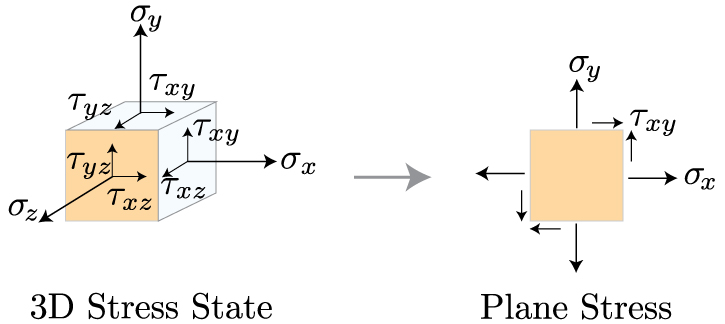
As midterms approached at Harton Institute of Technology, instructors in Mechanics of Materials found themselves repeating the same reassurance in office hours: rotating an element does not “change the stress,” it changes how the same stress is reported on a new set of faces. A one-page handout circulating on campus distilled the idea into a five-minute, exam-ready routine—equal parts equations, sign discipline and quick sanity checks.
1) What stays the same vs. what changes under rotation
- Stays the same (physical reality): the stress state at a point in the material.
- “If you didn’t load the structure differently, the physics didn’t suddenly change because you redrew the square,” said Dana Kline, a lecturer who has been fielding last-minute questions in the lab.
- Changes (how you describe it): the components on the rotated faces.
- Normal stresses on the new faces (σx′, σy′) and the shear on those faces (τx′y′) vary with angle.
- What that means on an exam: you are not “finding new stresses,” you are re-expressing the same stresses in a rotated coordinate system.
2) The equations and how to organize substitution
Students said the handout’s biggest help was forcing a consistent “plug-in order.”
-
Given on the original element:
- σx, σy, τxy and the rotation angle θ (from x to x′ by the problem’s convention).
-
Compute the average first (it shows up everywhere):
- σavg = (σx + σy)/2
-
Then compute the half-difference and the shear term:
- Δ = (σx − σy)/2
-
Use the standard transformation set (double-angle form):
- σx′ = σavg + Δ·cos(2θ) + τxy·sin(2θ)
- σy′ = σavg − Δ·cos(2θ) − τxy·sin(2θ)
- τx′y′ = −Δ·sin(2θ) + τxy·cos(2θ)
-
Substitution routine students were told to follow:
- Write σavg and Δ numerically.
- Evaluate cos(2θ) and sin(2θ) (in the right mode/units).
- Substitute into σx′ first, then use σy′ as a cross-check, and finish with τx′y′.
A senior, Priya Nandakumar, said she stopped “chasing signs” once she always wrote σavg and Δ on the page before touching trig.
3) Checklist for angle/sign selection
In recitations, teaching assistants treated the angle as the part most likely to derail a correct setup.
-
Angle definition:
- Confirm whether the problem’s θ is the rotation of the element or the orientation of the plane’s normal.
- Confirm direction: counterclockwise positive unless stated otherwise.
-
Shear sign convention (don’t guess):
- Use the course’s stated rule for positive τxy.
- If you sketch: label faces x and y clearly before assigning shear directions.
-
Double-angle reminder:
- The equations use 2θ, not θ.
- “Half the wrong answers in the stack were perfect—just at the wrong angle,” Kline said.
-
Units and calculator mode:
- Degrees vs radians errors, students said, were the silent killer under time pressure.
4) Mini debugging: 5 common errors and how to catch them
-
Using θ instead of 2θ
- Catch it: test θ = 0°. If you don’t get σx′ = σx, σy′ = σy, τx′y′ = τxy, the setup is wrong.
-
Swapping σx and σy (or mixing axes mid-problem)
- Catch it: compute σavg and make sure it matches (σx′ + σy′)/2 after you solve.
-
Flipping the shear sign convention halfway
- Catch it: for θ = 90°, the transformed shear should return with the expected sign per your convention; inconsistent signs often show up as a sudden “mirrored” answer.
-
Forgetting the negative in τx′y′ = −Δ·sin(2θ) + τxy·cos(2θ)
- Catch it: plug σx = σy (so Δ = 0). Then τx′y′ should become τxy·cos(2θ) with no extra terms.
-
Trig/units mistake (degrees vs radians or wrong reference angle)
- Catch it: do a quick magnitude check: |cos(2θ)| and |sin(2θ)| must be ≤ 1. If your computed trig values look off, stop and reset the calculator mode.
5) Final box: invariants and reasonableness checks
Faculty said the fastest way to protect points is to verify what must be true regardless of rotation.
-
Average normal stress is invariant:
- σavg = (σx + σy)/2 = (σx′ + σy′)/2
-
Symmetry check:
- σx′ + σy′ = σx + σy (sum of normals stays constant).
-
θ limits:
- θ = 0° → σx′ = σx, σy′ = σy, τx′y′ = τxy
- θ = 90° → the x′-face aligns with the original y-face; answers should reflect that swap.
-
If σx = σy (purely equal biaxial normal stress):
- Δ = 0, so rotation cannot create or destroy the normal difference; the only angle-dependence left is shear transforming with cos(2θ).
-
Reasonableness:
- Expect σx′ and σy′ to “trade off” around σavg as θ changes.
- If both transformed normals jump in the same direction away from σavg, instructors said to re-check signs and 2θ.
As one lab monitor put it while collecting practice quizzes, “The trick isn’t memorizing three equations. It’s remembering what can’t possibly change when you rotate a drawing.”