
The Lakehurst Sentinel
How to Tell if Something Is Alive (and Why Viruses Are Tricky)
A classroom field guide turns a perennial lunch-table argument into a checklist — then runs headlong into the gray area of things that act alive only under the right conditions.
SCIENCE & EDUCATION
LAKEHURST — Monday, January 29, 2026
By Marisol Vega
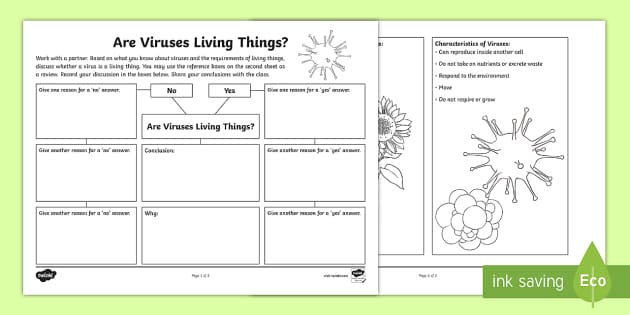
On a recent winter morning at Lakehurst Middle School, science teacher Dana Kline held up a sealed vial and asked her eighth-graders to take a side: alive or not. “No Googling,” she said. “Just your reasons.” The debate — equal parts confident and chaotic — quickly landed on the same culprit it always does: viruses.
Kline’s class wasn’t staging a stunt; it was piloting a one-page “field guide” designed by the district’s science coordinator to sharpen how students justify claims with evidence. The guide, handed out on bright white paper meant to survive backpacks and spilled water bottles, doesn’t try to end the argument so much as force it into the open.
“It’s not about winning,” Kline told the class, walking between lab tables as students scribbled. “It’s about being able to say why you think something meets the criteria.”
The guide’s starting point: a compact Cell Theory box
The top-left corner of the sheet carried a boxed summary students were expected to quote, not memorize.
CELL THEORY (classroom box)
- All living things are made of one or more cells. (Bacteria are one cell; oak trees are many.)
- The cell is the basic unit of structure and function in living things. (A muscle cell contracts; a leaf cell captures light.)
- All cells come from pre-existing cells. (New skin cells form by division of existing cells.)
Kline said the box helped students separate two conversations that often get tangled: whether something has life-like behaviors and whether it is cellular.
“In the wild, the first thing you can ask is, ‘Where are the cells?’” she said.
A property-of-life checklist — with examples that force specifics
The middle of the page featured a checklist. Students were told to mark each item with Yes / No / Only sometimes and then write a concrete example.
PROPERTY-OF-LIFE CHECKLIST (as used in class)
- Made of cells: A paramecium is a cell; a crystal is not.
- Uses energy (metabolism): Yeast breaks down sugar; a campfire consumes fuel but doesn’t regulate itself.
- Maintains internal balance (homeostasis): Humans sweat to cool down; a rock warms and cools without control.
- Grows and develops: A seedling becomes a plant; a snowball gets bigger by collecting snow.
- Responds to stimuli: A Venus flytrap snaps shut; a thermometer changes reading without acting to maintain itself.
- Reproduces: Bacteria split; mules can’t reproduce, but they come from living parents.
- Carries genetic information: DNA in a cell nucleus; RNA in some microbes.
- Evolves as populations over time: Antibiotic resistance spreads; a single object changing shape isn’t evolution.
At one table, students tested the checklist against fire.
“Fire uses energy and grows,” said eighth-grader Malik Hart, tapping his pencil. “It responds to wind. It spreads.”
His partner, Nia Gomez, drew a line under “homeostasis” and wrote “no.”
“It doesn’t keep itself stable,” she said. “It just burns until it can’t.”
Kline leaned in, pointing at the box on cell theory. “And does it have cells?” she asked.
Malik shook his head. “So it fails that.”
Across the room, the virus debate stalled the most.
“They have genetic material,” said student Lila Chen, “and they evolve. We hear about variants.”
Another student, Rowan Price, countered by circling “metabolism” and writing “needs host.”
“It doesn’t eat or make energy on its own,” Rowan said. “It’s like a USB drive: it needs a computer.”
A decision-tree flow that turns arguments into choices
The bottom half of the page was a text-only flow chart, read aloud as students tried to classify borderline cases.
DECISION TREE (text flow used in the pilot guide)
- Is it made of one or more cells?
- Yes → Go to 2.
- No / uncertain → Go to 4.
- Does it maintain homeostasis and perform metabolism using its own structures?
- Yes → Go to 3.
- No → Likely not alive, or alive only as part of a living system. Provide evidence.
- Can it reproduce (directly or via life cycle) and pass on genetic information?
- Yes → Living (justify with examples).
- No → Consider special cases (sterile organisms, life stages). Go to 5.
- Does it carry genetic information and evolve as a population?
- Yes → Go to 6.
- No → Not alive (justify).
- Is it part of a species that reproduces, even if this individual cannot?
- Yes → Living (individual limitation).
- No → Re-check criteria; justify.
- Can it reproduce and carry out key life processes without a host cell?
- Yes → Living (unusual, but justify).
- No → Virus-like / on the edge: describe what it does in a host, and what it cannot do alone.
Kline said the flow wasn’t meant to be a perfect scientific decree. It was meant to prevent students from skipping straight to a label.
“The moment someone says ‘It’s alive because it moves’ — the chart makes them slow down,” she said.
Why viruses keep breaking the rules
In Kline’s classroom, the virus in the vial never left its case. The students’ task was to argue from observed consequences and known behaviors, not from a microscope view.
Kline offered a scenario: a virus on a countertop.
“Does it use energy there?” she asked.
The room went quiet. Several students wrote “no” beside metabolism.
Then she described a virus inside a lung cell.
“Now what happens?”
“It makes copies,” Malik said. “But the cell does the work.”
Kline nodded. “So your justification has to include that dependency.”
A district handout accompanying the guide noted that viruses have genetic material and evolve rapidly, but lack cellular structure and do not maintain homeostasis or perform metabolism independently.
Students were encouraged to write conclusions like: “Virus-like: has genes and evolves, but requires a host cell for reproduction and metabolism.”
Common pitfalls students were warned about
Near the right margin, a section titled “Common pitfalls” listed mistakes Kline said she sees every year — and that show up in adult conversations, too.
- Confusing movement with life: A leaf can blow across a sidewalk; that doesn’t mean it is acting to survive.
- Using one criterion as a shortcut: “It reproduces” isn’t enough; computer programs copy, too.
- Ignoring the ‘made of cells’ question: Students sometimes argue only from behavior, skipping structure.
- Forgetting life cycles: Caterpillars and butterflies look different; both are part of the same living process.
- Treating “needs help” as automatic failure: Many living things depend on others (gut microbes, pollinators), but still have cells and metabolism.
- Mixing up individual and species-level reproduction: A sterile organism can still be living if it has cells, metabolism and comes from living parents.
- Overclaiming certainty with limited evidence: The guide asks for “uncertain” when evidence is missing, plus what data would settle it.
At the end of the period, students returned to the original prompt — alive or not — but with more nuanced language.
“I think it’s not alive by cell theory,” Lila said, “but it acts alive in a host. So I’m calling it ‘on the edge,’ and I can explain why.”
Kline collected the papers and said that was the point.
“I can work with a careful argument,” she said. “I can’t work with a shrug.”
A short self-assessment rubric for students’ justifications
The field guide closed with a rubric students used to score their own answers before turning them in.
SELF-ASSESSMENT (students circle one per line)
- Criteria named:
- Strong: I explicitly cited at least 3 criteria (cells, metabolism, homeostasis, reproduction, genes, evolution) and defined them in my own words.
- Developing: I cited 1–2 criteria or used vague wording.
- Weak: I used labels (“alive/not”) without criteria.
- Evidence and examples:
- Strong: I gave specific examples (what it does, when, under what conditions).
- Developing: I gave general statements without conditions.
- Weak: I relied on opinions or analogies only.
- Decision-tree reasoning:
- Strong: I followed the flow and explained where it branches and why.
- Developing: I jumped to a conclusion with partial steps.
- Weak: I didn’t use the flow.
- Counterarguments addressed:
- Strong: I stated at least one counterargument and responded using criteria.
- Developing: I mentioned a counterargument but didn’t answer it.
- Weak: I ignored counterarguments.
- Conclusion matches criteria:
- Strong: My label (living, not alive, virus-like/edge case) matches the criteria I cited.
- Developing: My label and criteria partly match.
- Weak: My label contradicts my own evidence.
Kline said she expects the guide to evolve with feedback. But she hopes one thing stays.
“Viruses are tricky,” she told the class, “because they make you prove you’re thinking.”