
The Grayford Ledger
In a Shop Class, a 720-Degree Lesson Turns Engine Theory Into a Four-Beat Rhythm
A community-college instructor walks beginners through intake, compression, power and exhaust — one crank rotation at a time — while stressing that valve overlap happens “near the edges.”
SCIENCE & MOTORING
GRAYFORD, Ind. — Monday, January 6, 2026
By Mara Ellison
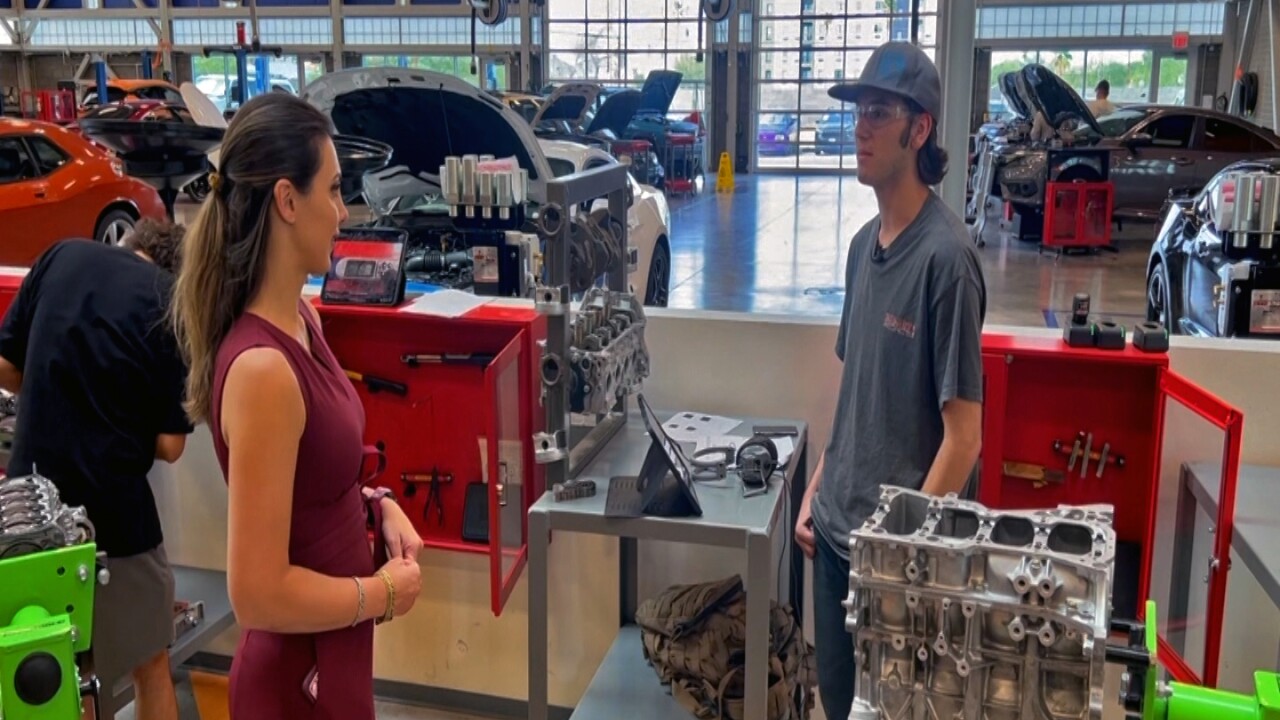
In Bay 3 of Grayford Community College’s automotive lab, instructor Dante Rios held up a grease-marked white card that read “720° = ONE CYCLE,” then tapped an exposed timing wheel bolted to a training engine. “If you can picture where the piston is and what each valve is doing,” he told a half-circle of first-time students, “the rest of engine talk stops sounding like magic.”
Rios’ students leaned in as a cutaway cylinder head revealed two springy valves and a piston crown that rose and fell like an elevator. He asked them to follow one complete cycle — two turns of the crankshaft, 720 degrees — and to repeat the same checklist for each stroke.
On the bench, he laid out the class’s “six-part callout,” a consistent, stroke-by-stroke pattern the group would chant back:
- (A) piston direction
- (B) intake valve state
- (C) exhaust valve state
- (D) what’s happening to the air-fuel charge
- (E) where the crank is roughly (degrees range)
- (F) why this stroke matters
The four-stroke cycle at a glance (class handout)
| Stroke | Crank degrees (approx.) | Piston | Intake valve | Exhaust valve | What happens to the charge | Why it matters |
|---|---|---|---|---|---|---|
| Intake | 0°–180° | DOWN | OPEN | CLOSED | Fresh mix rushes in | Fills the cylinder |
| Compression | 180°–360° | UP | CLOSED | CLOSED | Mix is squeezed, heated | Sets up a strong burn |
| Power | 360°–540° | DOWN | CLOSED | CLOSED | Spark ignites; pressure pushes piston | Makes useful torque |
| Exhaust | 540°–720° | UP | CLOSED (then begins to crack open near the end) | OPEN (then begins to close near the end) | Burned gases are expelled | Clears the cylinder |
Rios cautioned students not to treat the degree numbers like courtroom testimony.
“Real engines cheat around the edges,” he said, pointing to two lines on the timing wheel near top dead center. “That’s where overlap lives — near the edges — not ‘valves always open.’”
Stroke 1: INTAKE (fresh charge enters)
Rios steadied the timing wheel at the start mark and had students call out the checklist.
(A) Piston direction: DOWN
(B) Intake valve state: OPEN
(C) Exhaust valve state: CLOSED
(D) What’s happening to the air-fuel charge: The descending piston creates a pressure drop; air and fuel mist are drawn past the intake valve and into the cylinder.
(E) Crank position (rough range): 0°–180°
(F) Why this stroke matters: “No fill, no power,” Rios said, rapping the intake port with a knuckle. “Everything downstream depends on how much charge you trap.”
Labeled description from the class card:
- Intake valve OPEN (flow IN)
- Exhaust valve CLOSED
- Piston DOWN
- Crank: 0° → 180°
A student, Priya Shah, watched the clear tube feeding the intake and noticed the mist thicken when Rios cracked the throttle plate on a neighboring demo rig.
“So that’s why it feels lazy when an engine can’t breathe,” she said.
Rios nodded. “That’s the picture.”
Stroke 2: COMPRESSION (the squeeze)
Rios rotated the crank through the bottom of the stroke and stopped again.
(A) Piston direction: UP
(B) Intake valve state: CLOSED
(C) Exhaust valve state: CLOSED
(D) What’s happening to the air-fuel charge: The trapped mixture is compressed into a smaller space; pressure and temperature rise.
(E) Crank position (rough range): 180°–360°
(F) Why this stroke matters: “Compression is how you store energy in the charge,” Rios said. “A good squeeze makes the burn more decisive.”
Labeled description from the class card:
- Intake valve CLOSED
- Exhaust valve CLOSED
- Piston UP
- Crank: 180° → 360°
He tapped the spark plug hole and told the class to imagine the mixture “packed tight” beneath it.
“That’s the moment the engine is most sensitive to leaks,” he said, referencing worn rings and valves. “If you can’t hold pressure here, you feel it everywhere.”
Stroke 3: POWER (the push)
At the top of the compression stroke, Rios mimed the spark with two fingers.
(A) Piston direction: DOWN
(B) Intake valve state: CLOSED
(C) Exhaust valve state: CLOSED
(D) What’s happening to the air-fuel charge: The mixture ignites; expanding gases drive the piston down and turn the crank.
(E) Crank position (rough range): 360°–540°
(F) Why this stroke matters: “This is the only stroke that pays rent,” Rios said, prompting a few laughs. “Everything else is preparation or cleanup.”
Labeled description from the class card:
- Intake valve CLOSED
- Exhaust valve CLOSED
- Spark: FIRE near the start of the stroke
- Piston DOWN
- Crank: 360° → 540°
He pointed to the connecting rod as it swept through its strongest leverage angle.
“The crank is a lever that keeps changing,” he said. “You can watch the geometry turn pressure into rotation.”
Stroke 4: EXHAUST (clearing out)
Rios turned the wheel to the next top mark and let the class see the exhaust valve begin to move.
(A) Piston direction: UP
(B) Intake valve state: CLOSED (but starts to crack open near the very end)
(C) Exhaust valve state: OPEN (then starts to close near the very end)
(D) What’s happening to the air-fuel charge: Spent gases are pushed out through the exhaust port; pressure drops as the cylinder is scavenged.
(E) Crank position (rough range): 540°–720°
(F) Why this stroke matters: “If you don’t clear it, you can’t fill it,” Rios said, lifting a finger toward the intake runner. “Leftovers take up space.”
Labeled description from the class card:
- Exhaust valve OPEN (flow OUT)
- Intake valve CLOSED (then cracks OPEN near the end)
- Piston UP
- Crank: 540° → 720°
Overlap: “near the edges,” not “always open”
Rios marked two narrow arcs on the timing wheel at the transition from exhaust to intake.
“Here’s overlap,” he said, holding the wheel so students could see a moment when the exhaust side was not fully shut while the intake side began to open. “It’s brief, and it’s intentional. It’s not a permanent condition — it lives at the edges.”
He described it in shop-floor terms, not theory.
“You’re letting the last of the old air get tugged out while the new charge is lining up to come in,” he said. “But it’s a window, not a lifestyle.”
Student Miguel Alvarez wrote “EDGE WINDOW” in block letters at the top of his notes and underlined it twice.
The chant at the end of 720°
To close the session, Rios had the class point to the wheel and recite the cycle back as the crank returned to its starting mark.
“Two turns,” he said. “Four strokes. Same checklist.”
From across the bay, the training engine’s timing wheel clicked to 720°, and the students’ voices followed it:
- “Piston down — intake open — exhaust closed — fill the cylinder.”
- “Piston up — both closed — squeeze it tight.”
- “Piston down — both closed — burn makes torque.”
- “Piston up — exhaust open — clear it out — overlap near the edge.”
Rios set the wheel back to zero and wiped his hands on a rag.
“Now,” he said, “when someone says ‘timing,’ you’ll know what they’re pointing at.”